
ALL-NEW 2010 FORD F-150 SVT RAPTOR TAKES CUSTOMERS, TRUCK LEADERSHIP TO NEW VENUES, MORE EXTREMES
- Ford’s Special Vehicle Team (SVT) taps into growing off-road enthusiast market and builds on the Ford F-150’s solid foundation to deliver the ultimate off-road performance truck – the 2010 Ford F-150 SVT Raptor
- Internal triple bypass shocks by FOX Racing Shox – an industry-first on a production truck – help provide smooth ride; wider design key to harnessing all-new suspension and tire package
- The F-150 SVT Raptor launches with Ford’s proven 5.4-liter Triton® V-8 engine with 320 horsepower and 390 ft.-lb. of torque for a powerful punch; an all-new 6.2-liter V-8 engine will be available in early 2010
BORREGO SPRINGS, Calif., Aug. 17, 2009 – Preparing to blaze new trails, the all-new 2010 Ford F-150 SVT Raptor is ready for the most challenging desert adventures. But this purpose-built, high-speed off-road truck also is engineered to be versatile enough to take on the everyday commute.
“With Raptor, we’re taking the established performance of the F-150 to the next level and proving just how much Ford trucks can do,” said Derrick Kuzak, Ford’s group vice president for Global Product Development. “The F-150 SVT Raptor doesn’t just appear to be off-road-ready. It is off-road-ready. It was built with the off-road enthusiast in mind and will give consumers an off-road experience no other vehicle can.”
Ford’s Special Vehicle Team, known for engineering high-performance vehicles such as the Ford Shelby GT500, has outdone itself with the F-150 SVT Raptor. Combining the SVT performance strategy with the iconic F-150 brand, it delivers the ultimate in “Built Ford Tough.”
The 2010 F-150 SVT Raptor was built specifically to fulfill the desires of the highly demanding and growing off-road performance market. High-performance off-road trucks are a market that is largely untapped, allowing SVT Raptor to set the bar for this type of vehicle.
“We found a niche – off-road performance – that no other major manufacturers have filled, and we took it as an opportunity to differentiate F-150 from other trucks on the market,” said Mark Grueber, F-150 marketing manager. “Raptor is going to perform well anywhere you use it.”
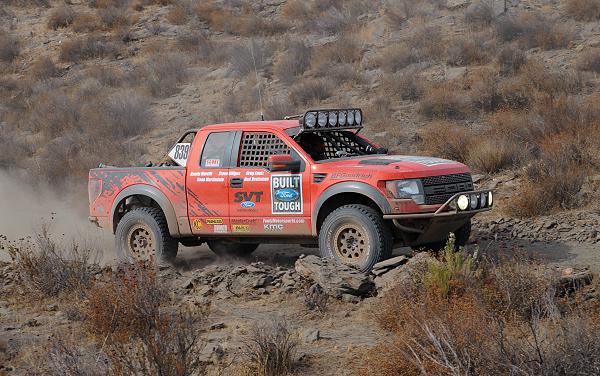
F-150 SVT Raptor also has a racing-ready version – F-150 SVT Raptor R – that has established its racing pedigree and performance capability.
Looks tough and fast
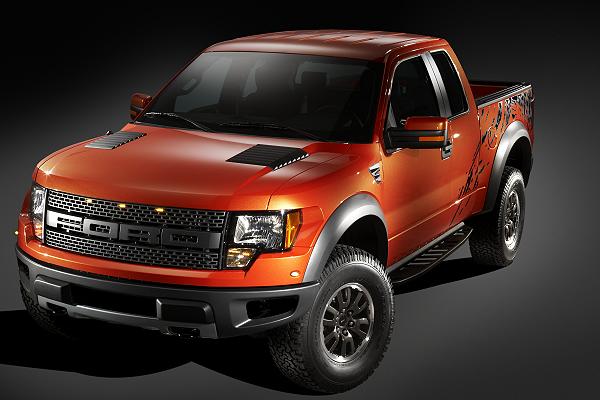
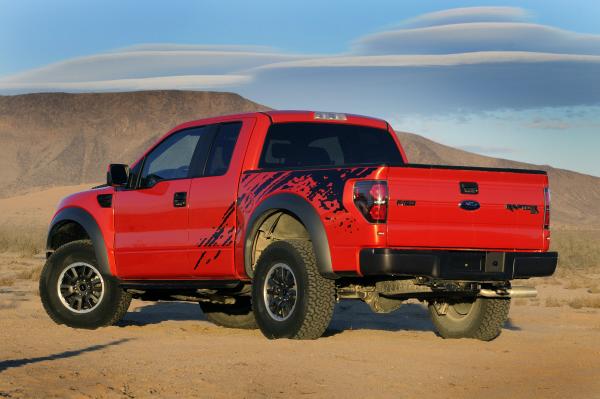
Built alongside the F-150 at Ford’s Dearborn Truck Plant, the new SVT Raptor takes the tough, chiseled look of the F-150 to a new level with a design that gives the impression it always is on the move.
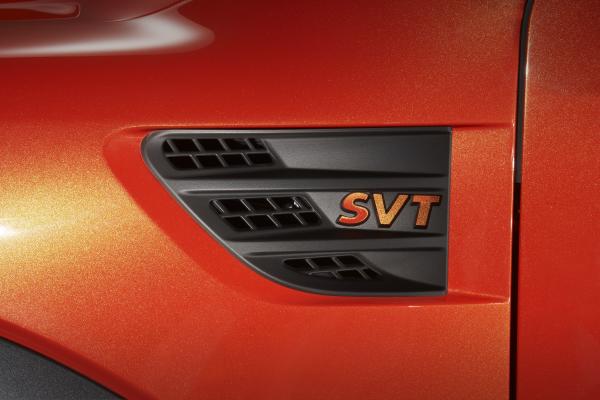
Noticeable exterior differences between the Ford F-150 SVT Raptor and the conventional F-150 start with a distinctive grille that has the Ford name carved into it. Additional exterior differentiation includes front bumper, front fascia and fenders, functional vented hood extractors, fender extractors with “SVT” bored out, visible FOX Racing Shox and skid plates on the underbody for protection.
Another key difference between Raptor and the base F-150 is that the SVT truck is more than seven inches wider, which was necessary to harness the wider suspension and larger tires. Designers took advantage of this difference and highlighted it with distinctive marker lamps integrated into the F-150 SVT Raptor’s front end, as opposed to on top of the cab. When lit up, Raptor’s imposing stance is immediately recognizable.
While the exterior design of the F-150 SVT Raptor is about creating an image, the interior design is about creating the feel of the truck, and both must complement each other.
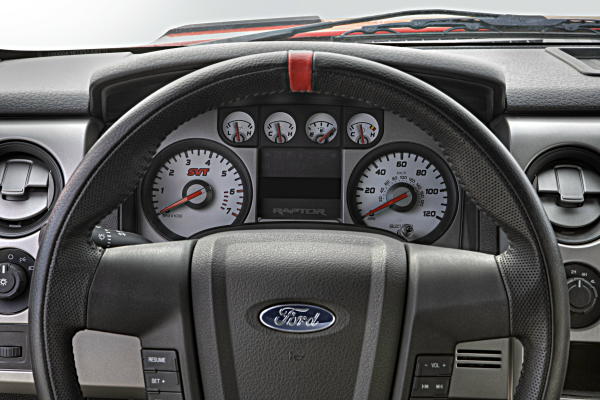
Design elements from the unique grille and front fascia have been carried through to the interior on the console and dashboard. The steering wheel is wrapped in black leather and features a Molten Orange leather strip that serves as a centering sight line – which is especially useful in extreme driving maneuvers. Two-tone leather-trimmed seats have upper and lower leather bolsters with fabric and perforated leather inserts, for a more comfortable ride.
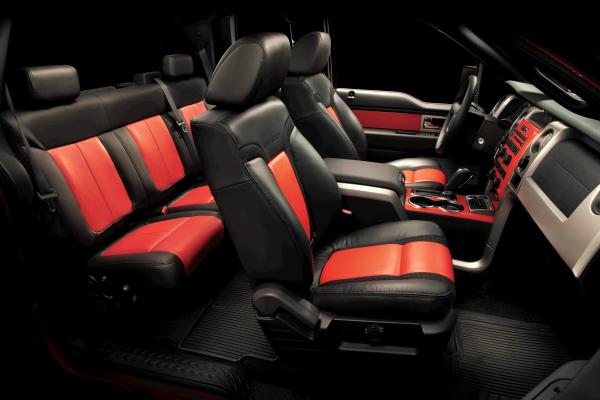
(Interior is also available in black leather without the orange)
|
All your important gauges are within eyeshot of the road ahead. |
|
The standard Black leather-wrapped steering wheel features a Molten Orange leather center strip that serves as a centering sight line during the most extreme off-road driving adventures. |
|
Unique SVT gauges feature a white face and Ice Blue™ Lighting to help you keep your rpm in check when the sun goes down |
|
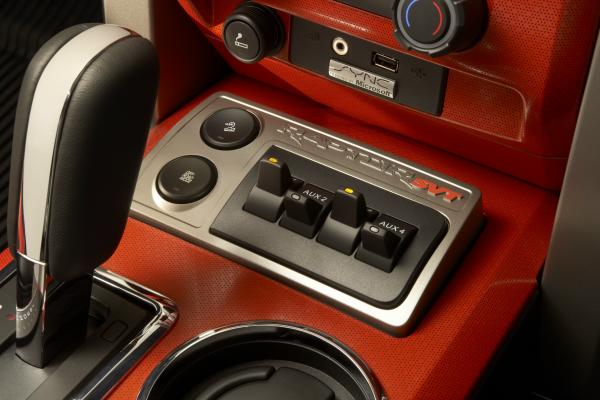
The auxiliary switch board on the center console makes aftermarket customization easier, with four prewired switches attached to the power distribution box for electrical accessories. |
|
Also located on the auxiliary switch board are two switches for improved off-road performance at the push of a button – hill descent control and off-road mode. |
Revved up and ready
The Ford F-150 SVT Raptor is powered by F-150’s proven 5.4-liter Triton V-8 three-valve engine, which delivers 320 horsepower and 390 ft.-lb. of torque to power the truck through any terrain it faces. After launch, in early 2010 customers will have the option of a new 6.2-liter V-8 engine capable of an estimated 400 horsepower and 400 ft.-lb. of torque.
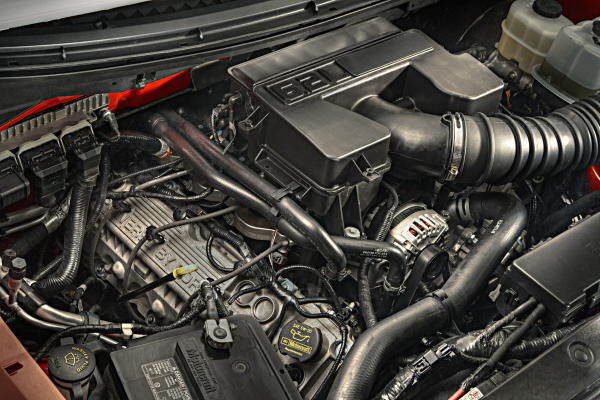
Standard 5.4L SOHC V8 FFV engine with up to 320 hp and 390 lb.-ft. of torque. Available 6.2L SOHC V8 engine (available winter 2010) with approximately 400 hp and 400 lb.-ft.
The Ford powertrain team performed extensive testing to ensure the engines would live up to the Built Ford Tough promise. Hundreds of additional tests beyond the normal verification of truck engines, as well as vehicle testing on a 62-mile durability loop in the desert validated the performance of both engines for reliability and longevity in the harshest conditions.
Takeoff and landing
For the F-150 SVT Raptor, Ford changed the axle and the whole front suspension – with a new upper A-arm, new lower A-arm, new tie rod and new half-shaft joints. The truck also provides 12.1 inches of usable travel in the rear suspension and 11.2 inches in the front for a smooth ride – both off- and on-road.
“Building a high-performance off-road truck is not about the horsepower – it’s about the suspension – and the F-150 SVT Raptor doesn’t disappoint,” said Jamal Hameedi, Ford SVT chief nameplate engineer. “It’s well beyond what SVT has ever done with one of our vehicles.”
Raptor’s wider track and softer suspension mean it will comparatively glide over obstacles. And when it has to be “launched,” be prepared for a soft landing.
“The suspension does all the work to keep the truck’s attitude stable,” added Hameedi. Along with a beefed-up suspension, the F-150 SVT Raptor also boasts unique internal triple bypass FOX Racing Shox – an industry-first on a production truck. The position-sensitive dampening internal bypass feature allows the shock to become significantly stiffer as it travels, preventing the truck from bottoming out.
By working with FOX internal bypass technology and applying the Ford engineering methodology, there haven’t been trade-offs to assure extreme off-road handling over on-road ride comfort.
“We took the best of both worlds, the technical knowledge and understanding of off-road, shocks and tuning that FOX has, and the SVT knowledge of on-road, and melded it together and came up with a great solution,” said Kerry Baldori, SVT chief functional engineer.
|
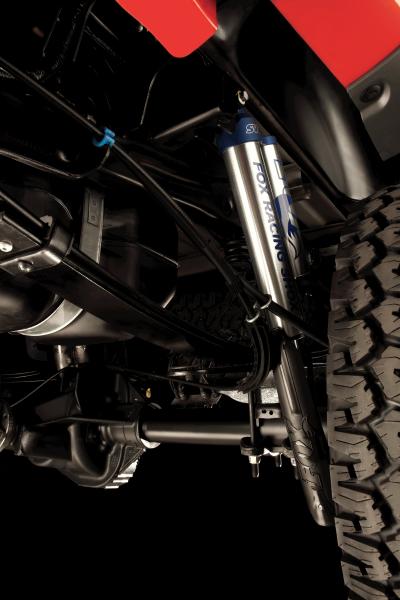
A special 4.10 rear axle and unique rear springs team up with standard internal bypass outboard-mounted FOX Racing Shox to deliver improved ride and handling, and 12.1″ of rear suspension travel. |
|
An external piggyback reservoir helps maintain the shock rates during severe usage, while an electronic locking rear differential is on board for times when maximum traction and power are desired. |
|
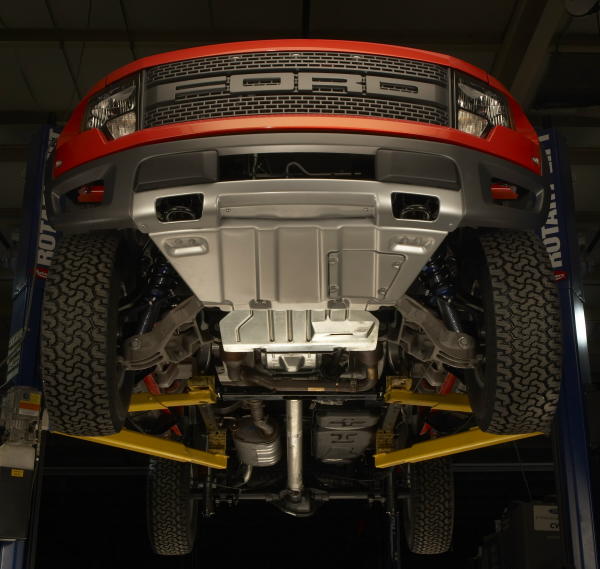
A massive front skid plate helps protect the front underbody and engine from impacts with unforgiving terrain. |
|
The compartment underneath also allows for easy access to your vehicle service needs |
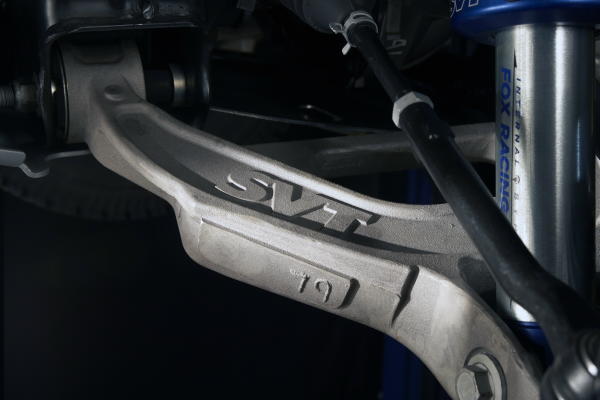
Unique cast-aluminum SVT front control arms deliver Built Ford Tough capability and confidence to handle rugged terrain.
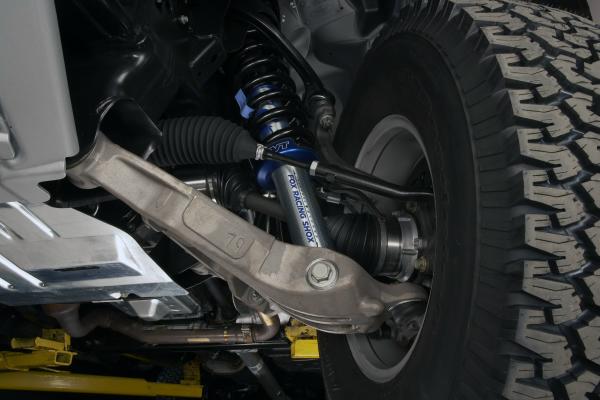
|
The standard front internal bypass FOX Racing Shox provide position-sensitive damping, which helps deliver improved traction, stability and comfort – reducing driver fatigue. |
|
These purpose-built, internal bypass shocks allow variable shock rates based on wheel position for agile performance off-road and on. And they help control an impressive 11.2″ of front suspension travel |
Tough truck, tough tires
The 2010 Ford F-150 SVT Raptor also sports an SVT-tuned 35-inch BFGoodrich® All-Terrain TA/KO 315/70-17 tire, which features a special tread compound to help provide precise and predictable steering.
To improve the tire’s performance under a variety of conditions, engineering altered the compound of the tread, making the rubber softer for better performance on- and off-road. The interior of the tire also was modified to improve lateral firmness.
The tall sidewall on the 35-inch tire can handle rocks and irregular surfaces commonly experienced in an off-road environment. A 17-inch cast-aluminum wheel is designed to absorb the impact of objects the truck could encounter in some of the most extreme environments. Engineers were also able to fit a full-size spare tire on the truck for customer convenience.
Specialized technologies
The F-150 SVT Raptor provides the complete package for off-roaders, including state-of-the-art technologies and Class III 6,000-pound towing capability.
“For many years enthusiasts have been struggling with the performance of electronic technologies in the extreme off-road environment since that was not the environment they were designed for,” Hameedi said. “What SVT has done is tailor technology to function in both an on-road and an extreme off-road environment.”
The F-150 SVT Raptor offers an entire suite of connectivity features, including Ford SYNC®, SIRIUS Travel Link™, Voice-Activated Navigation and Sony® Audio System. Additional technologies on the truck include:
- AdvanceTrac® with RSC (Roll Stability Control™) oversees the vehicle’s path using a sensor to detect and measure oversteer and understeer by monitoring the vehicle’s speed, throttle position and steering wheel angle. When the system senses wheel slip or the loss of traction, it applies braking where needed to keep the truck tracking on its intended path.For those who want even more vehicle control, a driver can switch to two available settings – sport mode and full Off-Road Mode – by holding down a button. The sport mode optimizes traction control for acceleration and seamless torque control, allowing the driver to feel like he is in control, versus the system being in control of the truck. Allowing the vehicle to have wider yaw thresholds, sport mode still will be active once the larger thresholds are met.Full Off-Road Mode shuts off all electronic stability programs except for the Anti-Lock Brake System (ABS) – and even ABS switches to an off-road setting, allowing for more tire slip, which improves stopping distances.
- Trailer Sway Control works in conjunction with AdvanceTrac with RSC and can determine from the truck’s yaw motion if the trailer is swaying and take measures – such as applying precise braking or reduced engine torque – to bring both vehicle and trailer under control.
- Integrated Trailer Brake Controller is factory-installed and allows direct operation of the trailer’s electronic brakes by squeezing the control module on the instrument panel with more confidence than the typical aftermarket system.
- Tow Haul Mode changes points under acceleration, keeping the truck at a higher rpm and further up in the power range. Tow Haul also prevents the transmission from upshifting when the vehicle crests a hill, and it provides downhill braking that allows the transmission to downshift, letting engine-compression braking slow the vehicle and maintain a steady speed.
- Electronic Locking Differential uses a true mechanical connection to lock the left and right rear axle shafts together so both turn at the same speed with the same amount of torque. This switch-controlled feature maximizes traction capability at the wheel, without having to stop the truck. Unlike other trucks on the market, the F-150 SVT Raptor’s differential can stay locked up to its 100-mph top speed.
- Hill Descent Control™ on F-150 SVT Raptor is Ford’s first application of the technology. Using ABS, the driver can control hill descent without applying the brakes. The speed is set for the truck to descend the hill by pushing a button and allows for the driver to concentrate on driving, rather than on how to modulate the brakes on a steep decline.
- Off-Road Mode engages a third throttle map and a third shift schedule for improved off-road performance. A third throttle map alters the throttle by changing the driver demand table so it is better suited to high- and low-speed off-road driving conditions. A third shift schedule is a unique strategy for the off-road environment that holds the transmission in each gear for a longer period of time, allowing better engine throttle modulation to control the vehicle.
- Auxiliary Switch Board on the center console makes aftermarket customization easier, with four prewired switches attached to the power distribution box for electrical accessories. Also located on the Auxiliary Switch Board are two switches for improved off-road performance – Hill Descent Control and Off-Road Mode.
Ford and off-road racing
Ford trucks have been a mainstay on the off-road racing scene for more than 20 years because of their long history of capability and durability. And desert off-road racing is something Raptor does well, proved by F-150 SVT Raptor R – the racing version of production Raptor – surviving the grueling 41st Tecate SCORE Baja 1000 this past November.
Prepared for racing in long-distance off-road endurance events, the F-150 SVT Raptor R uses stock components of F-150 SVT Raptor, including the frame, engine, steering, brakes, transmission and 4×4 system.
Along with the 2008 showing, Ford has displayed dominance in previous Baja 1000 races. Twelve Ford-powered vehicles have won the overall title for four-wheel vehicles – the most of any engine manufacturer.
Ford also is leading the off-road desert endurance championship chase in the Best in the Desert race series. With the 2009 season approaching the halfway point, drivers of Ford vehicles are leading seven of eight truck-eligible classes. The Raptor R is in second place in Class 8000.
Technical Specifications:
| Body | |
| Final assembly location | Dearborn Truck Plant, Dearborn, Mich. |
| Powertrain & Chassis | |
| Engine *Indicates E85 performance | |
| Type | 5.4-liter three-valve EFI V-8 FFV |
| Manufacturing location | Windsor Engine Plant, Windsor, Ont. |
| Configuration | Iron block, aluminum heads |
| Valvetrain | SOHC, three valves per cylinder, variable camshaft timing |
| Bore x stroke | 3.55 x 4.16 inches |
| Displacement | 330 cubic inches (5,400 cubic centimeters) |
| Compression ratio | 9.8:1 |
| Horsepower | 320 hp @ 5,200 rpm* / 310 hp @ 5,000 rpm |
| Torque | 390 ft.-lb. @ 3,500 rpm* / 365 ft.-lb. @ 3,500 rpm |
| Fuel capacity | 26.0 gallons |
| Fuel injection | Sequential multi-port electronic |
| Oil capacity | Seven quarts |
| Fuel economy | 14 mpg city / 18 highway |
| Engine | |
| Federal standards | Yes |
| California standards | Yes |
| Drivetrain | |
| Layout | Four-wheel drive |
| Transmission | |
| Standard | Six-speed automatic overdrive with Tow Haul Mode |
| Gear Ratios | |
| First | 4.17:1 |
| Second | 2.34:1 |
| Third | 1.52:1 |
| Fourth | 1.14:1 |
| Fifth | 0.86:1 |
| Sixth | 0.69:1 |
| Reverse | 3.40:1 |
| Available axle ratios | 4.10 |
| Suspension | |
| Front 4×4 | Coil-on-shock, long-spindle double-wishbone independent, aluminum lower control arm, forged steel upper arm |
| Rear 4×4 | Hotchkiss-type non-independent live, leaf springs and outboard shock absorbers |
| Steering | |
| Type | Power rack-and-pinion |
| Turning circle curb-to-curb | 44.6 feet |
| Brakes | |
| Front | 13.8-inch vented discs |
| Rear | 13.7-inch vented discs |
| Assist type | Vacuum, RSC |
| Wheels & Tires | |
| Wheels | 17-inch cast-aluminum wheels |
| Tires | LT315/70R-17 BSW A/T |
| Dimensions (inches unless otherwise noted) | |
| Exterior | |
| Wheelbase | 133 |
| Vehicle length | 220.9 |
| Vehicle width (without mirrors) | 86.3 |
| Vehicle height at curb | 78.4 |
| Track width, front/rear | 73.6/73.6 |
| Cargo box length | 67.0 |
| Width (max) between wheels | 50.0 |
| Inside box height | 22.4 |
| Interior | |
| Seating capacity | Five |
| Headroom | |
| Front | 41.0 |
| Rear | 39.7 |
| Legroom | |
| Front row | 41.4 |
| Second row | 33.4 |
| Shoulder room | |
| Front row | 65.9 |
| Second row | 65.7 |
| Hip Room | |
| Front row | 60.5 |
| Second row | 65.4 |
| Weights & Towing (pounds) | |
|
Super Cab 4×4 |
|
| Base curb weight | 5,863 |
| Payload capacity | 1,020 |
| GVWR | 6,950 |
| Conventional Towing – Maximum Loaded Weight Ratings (pounds) | |
|
Super Cab 4×4 |
|
| Axle ratio | 4.1 |
| Maximum GCWR | 12,300 |
| 133-inch wheelbase | 6,000 |
Note: Maximum loaded trailer weights shown. The combined weight of the towing vehicle (including hitch, passenger, cargo) and the loaded trailer must not exceed the Gross Combination Weight Rating (GCWR). See RV and Trailer Towing Guide for requirements, restrictions and fifth-wheel towing. Specifications subject to change
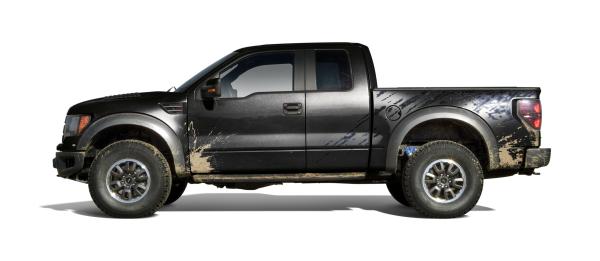
Colors:
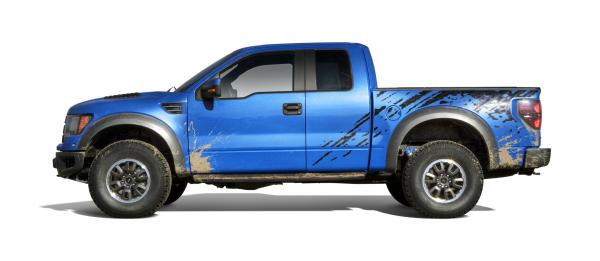
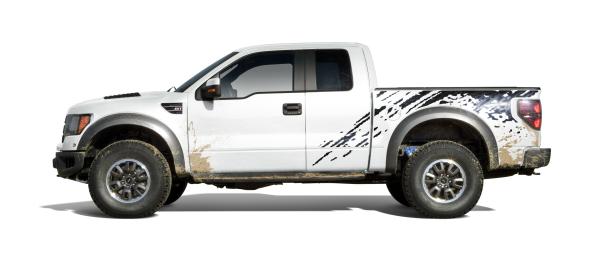
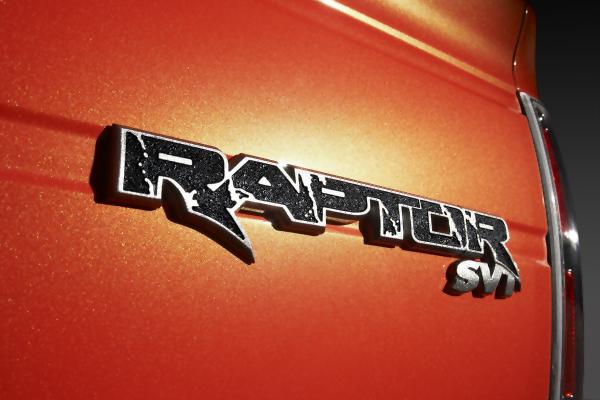
In addition to the orange, the Raptor is also available in:
About The Author

Growing up, my father always believed that every family needed a truck—there’s just something about having a vehicle capable of hauling anything at a moment’s notice. That philosophy stuck with me, and it’s been the foundation of my lifelong passion for Ford trucks.
While I’m best known for my work with Ford Rangers, I’ve owned a wide variety of Ford trucks over the years—including F-150s, F-250s, F-350s, and even larger rigs like the Ford Excursion, Ford Expedition, and a 1982 Ford Econoline Sportsmobile camper van. I’ve used these vehicles for everything from family transportation to towing car trailers and campers, and each one has fueled my love for Ford’s versatility and durability.
I especially enjoy the styling of 1970s and 1980s Ford trucks—the bold designs, rugged presence, and classic charm are timeless. Sharing my passion for Ford trucks, vans, and SUVs with other enthusiasts online brings me a great deal of joy, and it’s why I created Blue Oval Trucks.
This website is dedicated to helping Ford truck enthusiasts explore, learn about, and celebrate these incredible vehicles. While I share my expertise and experiences here, Blue Oval Trucks is an independent enthusiast site and is not affiliated with Ford Motor Company.