
Article By: Mark Wildman – Field Service Representative – International Truck and Engine Corporation
The mid-summer heat is intense across the country – which means the biggest concern for your diesel truck, van or SUV is your cooling system. There are several options for coolants on the market today, and not all of them are good for your engine. This article addresses the differences between conventional and extended life coolants, why your diesel engine’s well-being depends on proper coolant maintenance, and how to maintain your Power Stroke® Diesel engine so it can perform at its best all summer long.
Types of Coolant
There are three basic types of coolant: Ethylene Glycol (EG), or conventional coolant, is typically green; Long Life, or Extended Life, Ethylene Glycol is typically yellow; and Propylene Glycol (PG) is typically red and sometimes referred to as “non-toxic” coolant.
The term non-toxic can be confusing – all coolants are toxic, and should not be ingested. “Non-toxic” is associated with PG-based coolant because the United States Food and Drug Administration has classified Propylene Glycol as Generally Regarded As Safe (GRAS) in its pure form. The coolant manufacturer adds toxic chemicals to the PG base. Because of its toxicity, keep all coolants away from children and pets and dispose of all waste coolant properly.
PG coolant is not recommended for Power Stroke Diesel engines. Because of its chemical makeup, PG coolants can cause damage to aluminum parts, gasket materials and certain kinds of hoses. It also has a lower boiling point than EG coolant, usually 10 F to 15 F lower. While it may not sound like much, in a modern cooling system with a high output engine a few degrees may make all the difference in the world. Coolants that are methyl alcohol or methoxy proponol-based should also never be used.
Extended Life Coolant
Extended life coolants are available for newer model diesel engines (2002 model year). Extended life coolants provide a longer service interval under normal conditions, because they don’t require the addition of supplemental coolant additives (SCA). These new coolants use advanced organic acid technology, which depletes much more slowly than traditional coolant additives, to protect the engine.
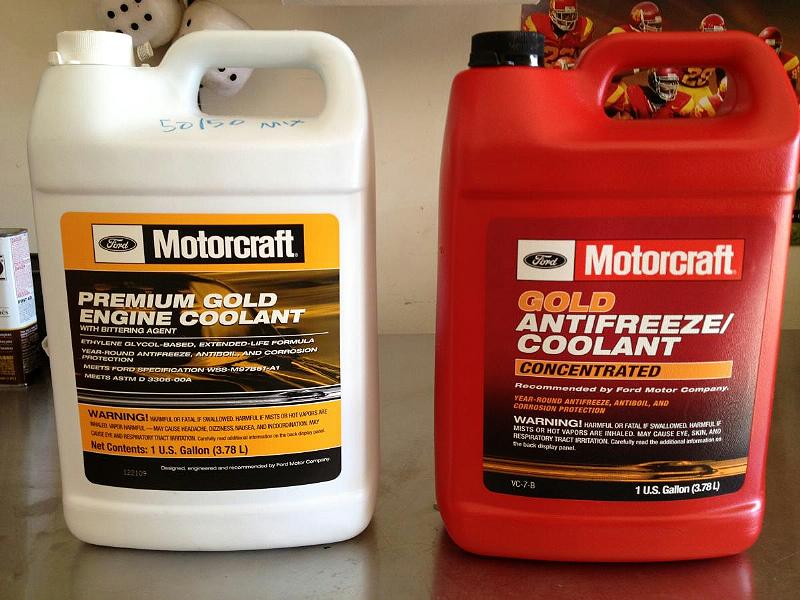
Ford Motor Company has determined that either conventional Ethylene Glycol (green colored) or Extended Life Ethylene Glycol (yellow colored) coolant, such as Motorcraft Premium Gold Engine Coolant, will meet the needs of the cooling system and will perform well in extreme conditions as long as the vehicle is operated correctly. PG-coolants such as Motorcraft Specialty Orange are not recommended for the Power Stroke Diesel engine.
Extended Life EG coolants used with the 2002 model year F-Series pickups and Excursions will allow for intervals of 100,000 miles or five years, which ever occurs first, and will not need SCAs if they are maintained properly. All 2001 model year and prior Power Stroke Diesel engines are not compatible with extended life coolant. These models had the proper amount of SCA added at the engine plant before they were shipped, but will need to be maintained as described in the “cavitation protection” section of this article.
If you have a 2002 model year engine, do not mix the Extended Life Ethylene Glycol (yellow) with the conventional Ethylene Glycol (green) under any circumstance. If you accidentally mix extended life coolant with conventional coolant and the mixture exceeds 10 percent, the coolant must be maintained as a conventional system using SCAs, or should be drained and flushed, then refilled with new extended life coolant.
Conventional EG Coolant
The proper mix of coolant is important when using conventional green coolants. If the coolant concentration is too high in a vehicle’s cooling system, then silicates will separate and drop out of the coolant. These silicates can form a paste that plugs heater cores, radiator tubes and may lead to water pump failure if a large amount of the silicate paste lodges between the seal lip and the seal’s riding surface. Silicate paste can also plug small passages in the engine, leading to damaging hot spots. Too low of a coolant concentration, on the other hand, may lead to freezing, which can also cause engine damage.
A proper coolant concentration is also needed to protect against corrosion in the cooling system. If the concentration is too low, rust and corrosion can take place inside the cooling system and lead to water pump failure. Scale build up can lead to hot spots on cylinder walls that can cause pistons to scuff or score. Rust and corrosion can also cause erosion damage to the aluminum parts of the engine and may result in expensive repairs.
The recommended coolant concentration is a 50/50 mix of coolant with distilled water. The maximum acceptable coolant system concentration is 60 percent in extreme conditions. In these conditions, follow the chart on coolant container for the recommended water to coolant ratio. The minimum concentration should not go below 40 percent.
Cavitation Protection and SCAs
SCAs provide cavitation protection for conventional green coolant. Cavitation is erosion that occurs on the outside diameter of the cylinder wall, and can happen if vapor bubbles form in the cooling system and attach to the wall.
Every time the pistons move up and down, they rock in the bore, causing the cylinder wall to vibrate. Vapor bubbles can form on the outside of the cylinder wall as it moves inward, or away from the coolant, creating a low-pressure area. When the cylinder wall moves outward, or into the coolant, the pressure increases on the vapor bubbles. After many cycles, vapor bubbles continue to form and the pressure on the bubbles increases until, finally, a vapor bubble collapses. When this happens, it creates a localized stress area of more than 50,000 psi. The high pressure and heat created by the implosion removes a small amount of cylinder wall material where the vapor bubble was attached. Over time, the cylinder wall can continue to erode, and eventually may form a pinhole in the wall that allows coolant to enter the combustion chamber, leading to possible engine failure.
Unlike diesel engines, gas engines do not need cavitation protection. This is because diesel engines are more likely to be used in heavy-duty applications and operate under higher loads for longer periods of time. By nature, diesel engines often have cylinder pressures greater than twice the cylinder pressure of a gasoline engine. This combination of high load and high combustion pressures creates the violent cylinder wall vibrations that lead to cavitation. Most gasoline engines will not experience enough of this kind of operation in its life to cause a failure. Although rare, there have been occurrences where a gasoline engine did fail from cavitation erosion.
You can protect your diesel engine from cavitation by adding the proper amount of SCA to an EG cooling system. When used properly, SCAs help neutralize acids and provide anti-foam protection as well as prevent cavitation, scale and general corrosion. SCAs work to prevent cavitation by forming a protective coating on the cooling system surfaces. This coating will provide a barrier between the cylinder wall and the vapor bubbles. The vapor bubble implosions erode the SCA protective coating instead of the cylinder wall.
If your cooling system was originally equipped with green coolant, you will periodically need to maintain your coolant’s additive package. The higher the loads and the more miles, the more the SCA is depleted from the system. Under normal service conditions, you will need to add 8 to 10 ounces of SCA every 15,000 miles, as identified in your Scheduled Maintenance Guide. Under severe service (e.g. towing a trailer) add 16 ounces. We recommend Motorcraft? Heavy Duty Cooling System Additive, part #FW-16 or equivalent. The equivalent will be referred to as DCA4 and meets material specification ESN-M99B169-A. At service intervals where the coolant is replaced, two 16-ounce bottles of SCA should be added.
Too much SCA in your cooling system can cause water pump seal failures. In most cases, if you follow the guidelines listed above, your Power Stroke Diesel cooling system will be in good shape. If there is a question about the level of SCA protection in the system, you can use test strips to check the level of SCA in the cooling system. A Fleetguard? test strip kit (DCA4 Test Strip Kit CC2602) can be found at International® truck dealerships. The $40.00 kit comes with 50 strips and expires in one year, so this may not be practical for the individual user. Most medium and heavy-duty truck shops will test your cooling system for a fee.
The test strip bottle has a scale that tells what level of protection the system has by matching the colors that are on the test strip. The strip has three pads that will turn color to indicate the amount of SCA in the system as units per gallon, and should read between 2 to 3 units for the Power Stroke Diesel. One pad indicates the freeze point level, and the other two indicate the SCA protection level by checking for nitrite and Molybdate. After you add SCA, wait to retest the system until it has been completely mixed, or driven for 30 continuous miles.
Maintenance Guidelines
To prevent unnecessary engine damage and keep your engine running in top condition, coolant system testing should be performed at least two times per year, preferably in the spring and fall. A Refractometer ($80 to $200) is the most accurate method for checking coolant temperature protection level. Refractometers work by magnifying the light properties of the coolant and displaying the results on a temperature scale.
A hydrometer is another common method for testing the cooling system. It works by checking specific gravity of the coolant. Hydrometers check the PH levels of the coolant and turn the strip to a varying shade of green. This color indicator is matched to a scale, indicating the level of temperature protection. If you use a hydrometer, be sure that it is made for Ethylene Glycol coolant.
Recommendations and Tips
Depending on the type of coolant your cooling system originally contained, you should use either Ford Premium EG (green) coolant (P/N E2FZ-19549-AA Ford reference number VC-4-A), an equivalent that meets specification ESE-M97B44-A, or Motorcraft Premium Gold Coolant meeting specification WSS-M97B44-D
Maintain a 50/50 mix using distilled water. Water that has minerals in it (or hard water) should not be used. The minerals will lower the boiling point and can increase corrosion in the system.
Under normal driving conditions, the green EG coolant should be changed at 48 months or 50,000 miles for the first time, then every 36 months or 30,000 miles every time after. SCAs must be added and maintained with this coolant.
If your cooling system is equipped with Motorcraft Premium Gold Engine Coolant (reference number VC-7-A), your coolant should be changed every 100,000 miles or 5 years, and no SCA added. Coolant may need to be changed more frequently if vehicle is under harsh driving conditions such as towing, heavy loads or operating in extreme temperatures.
About The Author

Growing up, my father always believed that every family needed a truck—there’s just something about having a vehicle capable of hauling anything at a moment’s notice. That philosophy stuck with me, and it’s been the foundation of my lifelong passion for Ford trucks.
While I’m best known for my work with Ford Rangers, I’ve owned a wide variety of Ford trucks over the years—including F-150s, F-250s, F-350s, and even larger rigs like the Ford Excursion, Ford Expedition, and a 1982 Ford Econoline Sportsmobile camper van. I’ve used these vehicles for everything from family transportation to towing car trailers and campers, and each one has fueled my love for Ford’s versatility and durability.
I especially enjoy the styling of 1970s and 1980s Ford trucks—the bold designs, rugged presence, and classic charm are timeless. Sharing my passion for Ford trucks, vans, and SUVs with other enthusiasts online brings me a great deal of joy, and it’s why I created Blue Oval Trucks.
This website is dedicated to helping Ford truck enthusiasts explore, learn about, and celebrate these incredible vehicles. While I share my expertise and experiences here, Blue Oval Trucks is an independent enthusiast site and is not affiliated with Ford Motor Company.