
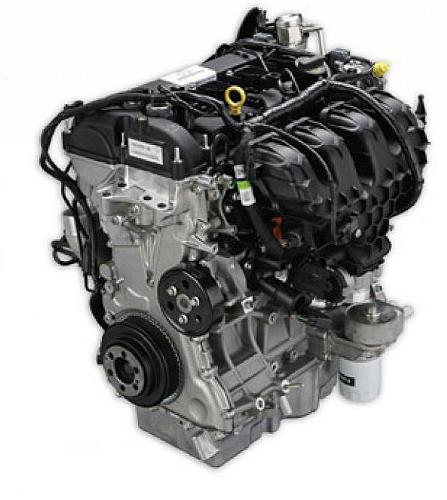
The Ford 2.0L EcoBoost engine debuted in 2010 as a turbocharged, inline four-cylinder direct-injection gasoline engine. Depending on model year and application, output ranges from approximately 200–252 horsepower and 221–270 lb-ft of torque. The design balances modest power with strong fuel efficiency, making it popular across multiple Ford platforms.
Early versions of the 2.0L EcoBoost were derived from the Mazda 2.0L L-Series engine block, but Ford implemented its own cylinder head design, a unique fuel injection system, and twin-independent variable cam timing (Ti-VCT).
2nd Generation Ford 2.0L EcoBoost
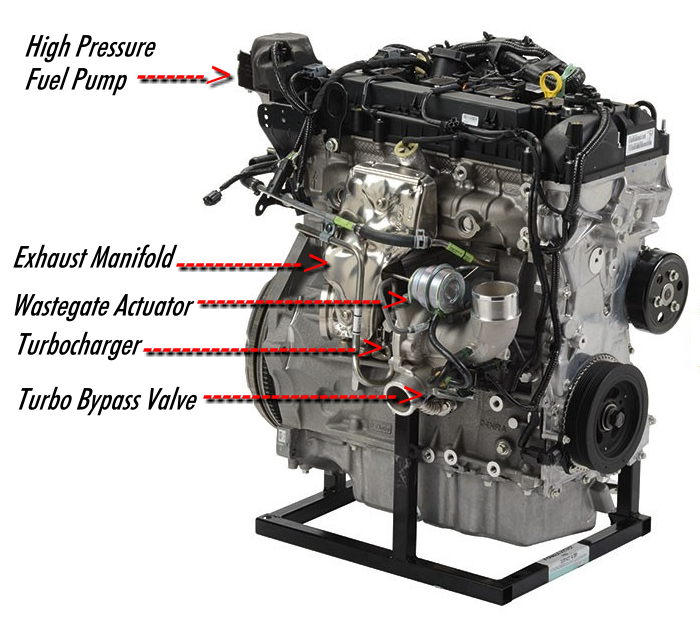
In 2015, the Ford–Mazda partnership ended, and Ford introduced a redesigned second-generation 2.0L EcoBoost. This version received a new aluminum engine block, a revised cylinder head with an integrated exhaust manifold, and a BorgWarner twin-scroll turbocharger equipped with an active wastegate.
Along with a higher compression ratio, Ford upgraded the fuel delivery and oil cooling systems. These changes improved fuel economy while increasing low-RPM torque, making the engine more capable in towing and load-bearing applications.
Ford 2.0L EcoBoost Common Problems
- Cracked exhaust manifold
- Turbo / boost control solenoid failure
- Low-pressure fuel pump (LPFP) failure
- Carbon build-up on intake valves
1) 2.0L EcoBoost Cracked Exhaust Manifold
Both generations of the 2.0L EcoBoost use an integrated stainless-steel exhaust manifold cast directly into the cylinder head. Under heavy load—such as towing or sustained uphill driving—exhaust gas temperatures can become excessive.
Repeated heat cycles cause the stainless steel to expand and contract. Combined with engine vibration, this thermal stress can eventually create hairline cracks in the exhaust manifold.
Symptoms of a Cracked Exhaust Manifold
- Whistling, whining, or chirping noises from the engine
- Poor engine performance
- Lack of acceleration
- Excessive boost or unusually high PSI readings
- Exhaust fumes entering the cabin
Driving with a cracked exhaust manifold can cause the turbocharger to overspool, potentially damaging the turbo. Either repair—manifold or turbocharger—can be expensive if the issue is ignored.
2) Turbo / Boost Control Solenoid Failure
The turbo control solenoid—often called the boost solenoid—regulates turbo boost by controlling the wastegate. It operates electronically through the ECM while using vacuum pressure to open and close the wastegate, which controls how much exhaust gas drives the turbocharger.
When the boost solenoid fails, it may incorrectly command the wastegate, causing the turbo to produce either too much or too little boost.
Boost solenoids are wear items. Over time, electrical components can fail due to corrosion, dirt contamination, moisture intrusion, or normal degradation. While many vehicles see solenoid lifespans of roughly 10 years, the 2.0L EcoBoost is known for failures occurring much earlier—often between 50,000 and 80,000 miles.
Symptoms of a Failing Boost Solenoid – 2.0L EcoBoost
- No boost under acceleration
- Poor performance or noticeable power loss
- Rapid or erratic changes in boost pressure
- Reduced fuel economy
- P0299 trouble code and check engine light
Although replacing the boost solenoid itself is not particularly expensive, access can be difficult. The valve is mounted on the turbocharger and is often buried deep within the engine bay.
3) Low-Pressure Fuel Pump (LPFP) Failure
Direct-injection fuel systems rely on two pumps: a low-pressure fuel pump (LPFP)
and a high-pressure fuel pump (HPFP). Because direct injection requires fuel pressures approaching 30,000 PSI, a single pump cannot realistically supply fuel from the tank while maintaining that pressure.
The LPFP draws fuel from the tank and supplies it to the HPFP, reducing strain on the high-pressure system. On the 2.0L EcoBoost, the in-tank fuel filter can become clogged, forcing the LPFP to work harder than intended.
High-Pressure Fuel Pump (HPFP) Issues
The HPFP itself is also prone to failure, which is common among direct-injection engines. Operating under extreme pressure, the internal impeller can weaken or break, resulting in insufficient fuel pressure.
LPFP / HPFP Failure Symptoms
- Engine misfires
- Lean air-to-fuel ratios
- Poor overall performance
- Lack of acceleration
- Rough idle
- Check engine light illumination
Both LPFP and HPFP failures result in inadequate fuel delivery. A bad LPFP starves the HPFP, while a failing HPFP cannot generate sufficient pressure on its own.
4) Carbon Build-Up on Intake Valves
Like all direct-injection engines, the Ford 2.0L EcoBoost is susceptible to carbon build-up. In port-injected engines, fuel passes over the intake valves and helps keep them clean. Direct injection bypasses the intake valves entirely.
Over time, oil vapor and combustion byproducts form carbon deposits on the intake valves. As buildup increases, airflow into the cylinders becomes restricted.
While carbon buildup develops slowly and may not be noticeable early on, it can eventually affect air-to-fuel ratios, reduce performance, and cause the engine to feel sluggish.
Ford EcoBoost Carbon Build-Up Symptoms
- Cylinder misfires
- Sluggish engine response
- Lack of acceleration
- Rough idling
Misfires are typically the first noticeable symptom. Carbon accumulation does not occur evenly across all valves, which leads to inconsistent airflow between cylinders. Power loss usually develops gradually over several years, making early diagnosis difficult.
Ford 2.0L EcoBoost Reliability
Overall, the Ford 2.0L EcoBoost is considered a reliable engine. There are relatively few widespread issues, and the internal components show solid long-term durability.
With proper maintenance, these engines can reliably exceed 150,000 miles. Beyond that point, owners should expect normal wear-related repairs such as fuel pumps, water pumps, hoses, turbo seals, and other supporting components.
About The Author

Growing up, my father always believed that every family needed a truck—there’s just something about having a vehicle capable of hauling anything at a moment’s notice. That philosophy stuck with me, and it’s been the foundation of my lifelong passion for Ford trucks.
While I’m best known for my work with Ford Rangers, I’ve owned a wide variety of Ford trucks over the years—including F-150s, F-250s, F-350s, and even larger rigs like the Ford Excursion, Ford Expedition, and a 1982 Ford Econoline Sportsmobile camper van. I’ve used these vehicles for everything from family transportation to towing car trailers and campers, and each one has fueled my love for Ford’s versatility and durability.
I especially enjoy the styling of 1970s and 1980s Ford trucks—the bold designs, rugged presence, and classic charm are timeless. Sharing my passion for Ford trucks, vans, and SUVs with other enthusiasts online brings me a great deal of joy, and it’s why I created Blue Oval Trucks.
This website is dedicated to helping Ford truck enthusiasts explore, learn about, and celebrate these incredible vehicles. While I share my expertise and experiences here, Blue Oval Trucks is an independent enthusiast site and is not affiliated with Ford Motor Company.