
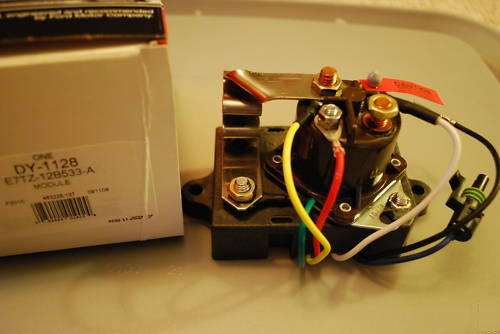
(1983-1994 Ford Glow Plug Relay/Controller)
Glow Plug Controller – Theory of Operation:
The controller consists of a four post automotive starter type relay that is bolted on top of a small black box (see above). Connecting the black box and the relay is a flat metal resistor. The black box contains a small electrical circuit board that has been sprinkled with a non conductive material, and then sealed. There are a total of six wires coming out of the black box.
The controller monitors the resistance in the glow plug circuit. Assuming that all the wires in the circuit are good and not rubbed through the insulation in any spots, there are just a couple things that change the resistance of the circuit:
The first thing that changes the resistance in the circuit, and the thing that the controller was designed to look for, is the heating of the glow plugs. As the plugs heat up their resistance increases, this holds true for any wire or metal with current flowing through it. When the resistance reaches a certain level the controller stops sending power to the plugs because they are hot enough for starting.
The second thing that causes the resistance of the system to change is burnt glow plugs or good plugs with a higher resistance. If there is one or more glow plugs burned out, then the controller sees a higher resistance in the circuit. The higher resistance causes the controller to think that the plugs are hot enough to start, even though they are not, and it will short cycle or not cycle at all. Remember that this is assuming the wiring in the circuit is in good shape, because a shorted wire will also change the resistance and cause the controller to think that the plugs are hot enough to start when they are not.
The problem with the factory controller logic is that it only takes one burned out glow plug to cause the system to think that the plugs are hot enough to start. It does get some input from a temperature sensor located near the water pump, but this sensor only tells it if the truck is hot or not, it doesn’t tell it the source of the resistance in the system. Therefore, the resistance in the circuit is the controller’s only way of knowing how long to supply power to the plugs.
About The Author

Growing up, my father always believed that every family needed a truck—there’s just something about having a vehicle capable of hauling anything at a moment’s notice. That philosophy stuck with me, and it’s been the foundation of my lifelong passion for Ford trucks.
While I’m best known for my work with Ford Rangers, I’ve owned a wide variety of Ford trucks over the years—including F-150s, F-250s, F-350s, and even larger rigs like the Ford Excursion, Ford Expedition, and a 1982 Ford Econoline Sportsmobile camper van. I’ve used these vehicles for everything from family transportation to towing car trailers and campers, and each one has fueled my love for Ford’s versatility and durability.
I especially enjoy the styling of 1970s and 1980s Ford trucks—the bold designs, rugged presence, and classic charm are timeless. Sharing my passion for Ford trucks, vans, and SUVs with other enthusiasts online brings me a great deal of joy, and it’s why I created Blue Oval Trucks.
This website is dedicated to helping Ford truck enthusiasts explore, learn about, and celebrate these incredible vehicles. While I share my expertise and experiences here, Blue Oval Trucks is an independent enthusiast site and is not affiliated with Ford Motor Company.