
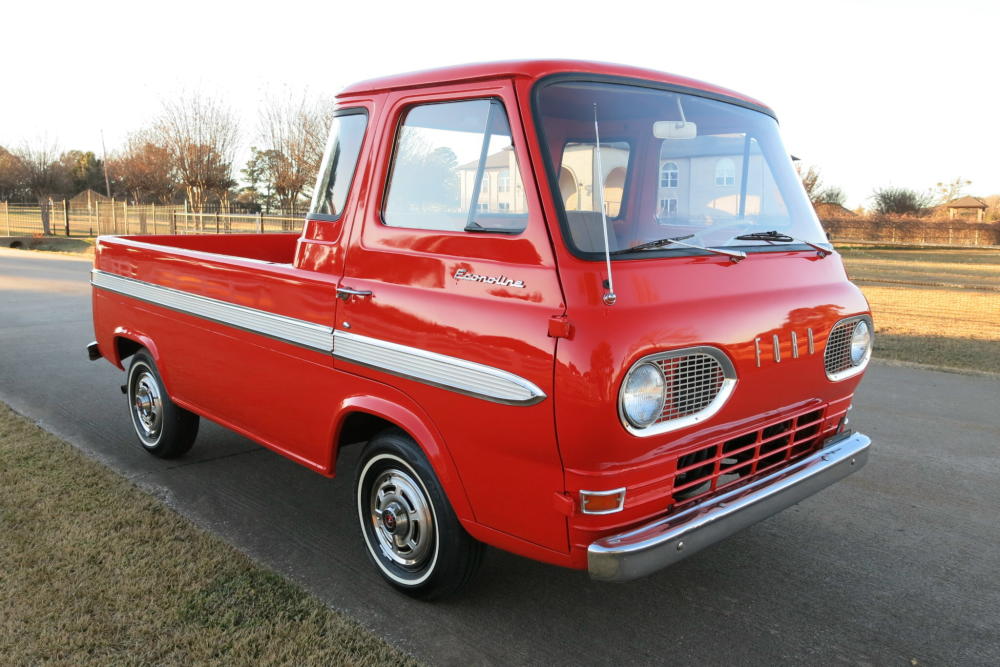
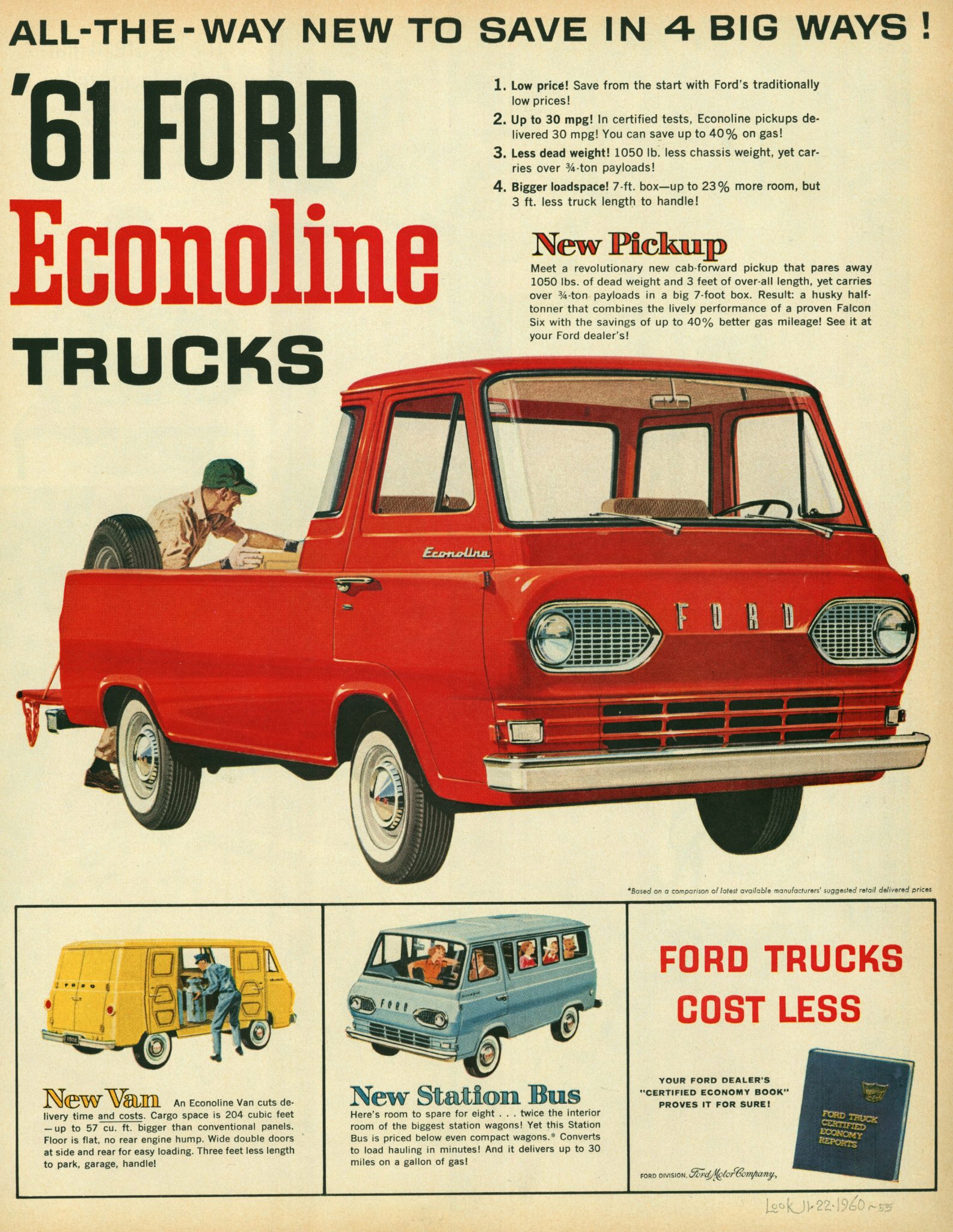
When Volkswagen (VW) started importing its bus into the US in the mid-1950s Ford, Chrysler, and GM all took notice. They each began developing “forward control” vans to compete. As with VW, all three used the drivetrains from its compact cars for power. In Ford’s case, it took the driveline from the Falcon and created a unibody van and pickup truck with an F-100 I-beam front end. With the driver’s compartment moved over that front axle and a 7-1/2 foot bed it had lots of loading space and could be made very cheaply.
Production
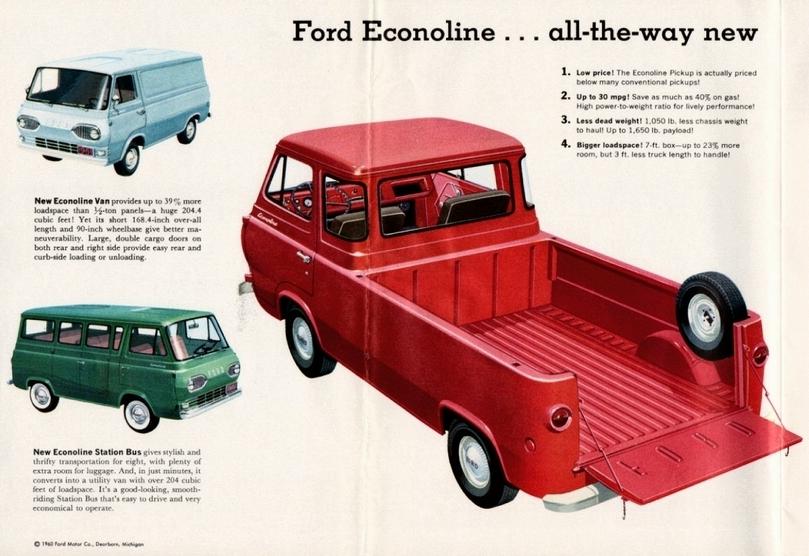
The first generation of the Ford Econoline made its debut on September 21, 1960. Introduced for the 1961 model year as a cargo van, pickup truck, and a passenger van (Station Bus/Club Wagon).
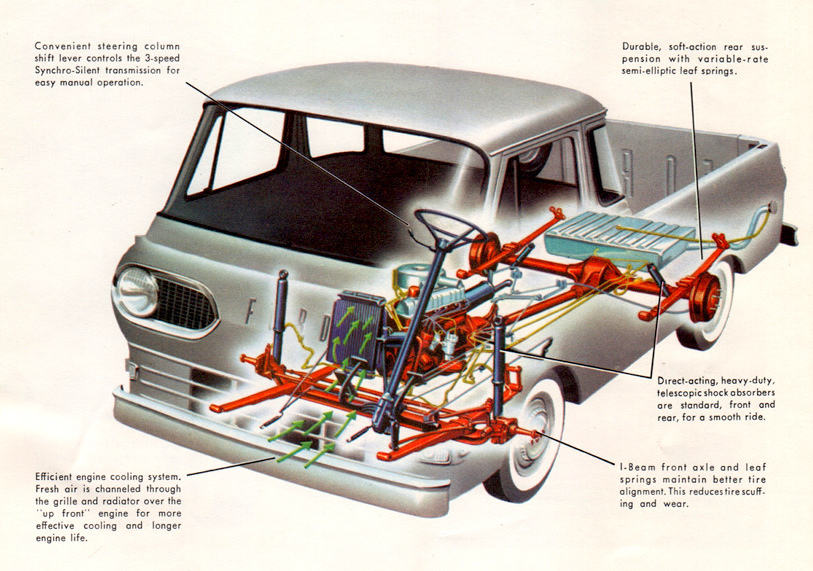
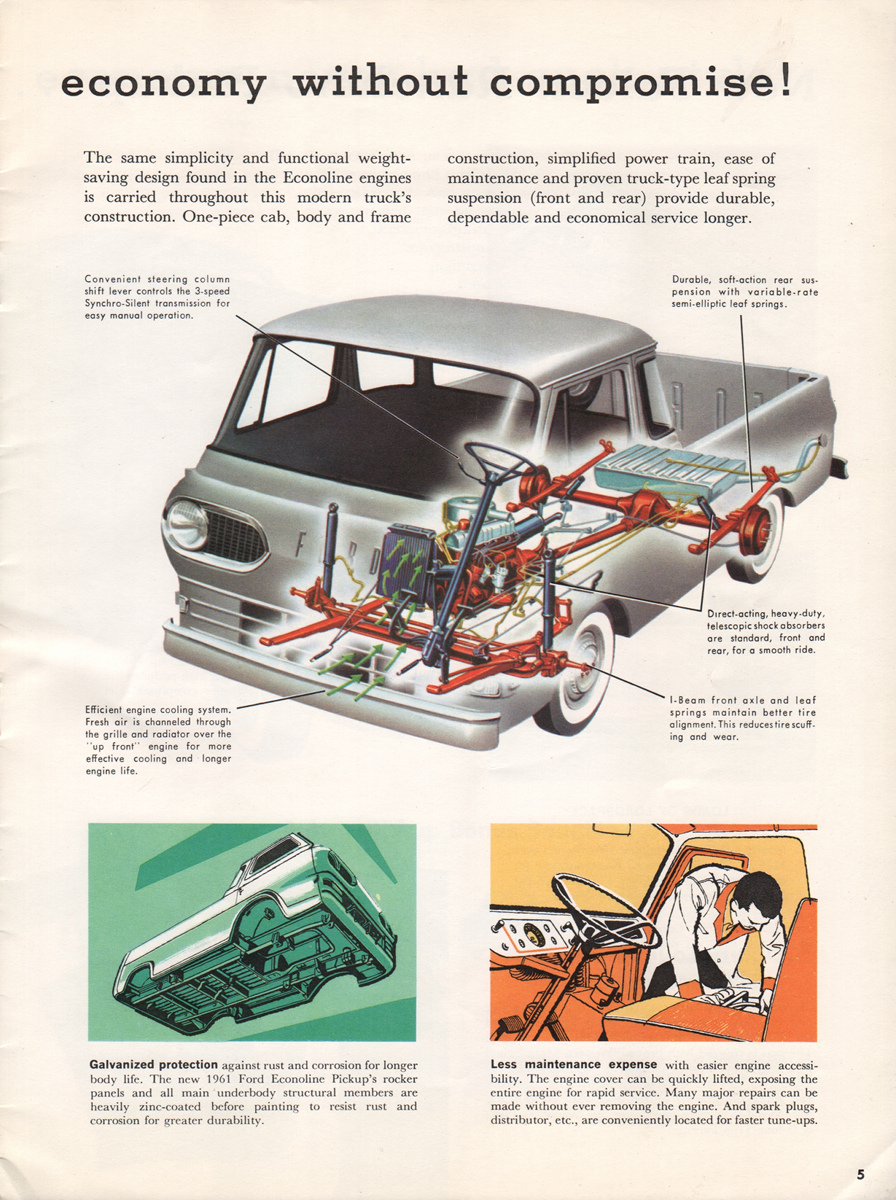
While introduced alongside the Chevrolet Corvair van for 1961, the Ford Econoline established many design precedents adopted by successive designs of American vans, including the Chevrolet Van and Dodge A100 (and the European Ford Transit). While remaining a forward-control vehicle, Ford adopted a mid-engine configuration, placing the engine behind the front axle. This prevented the use of a V8 engine.
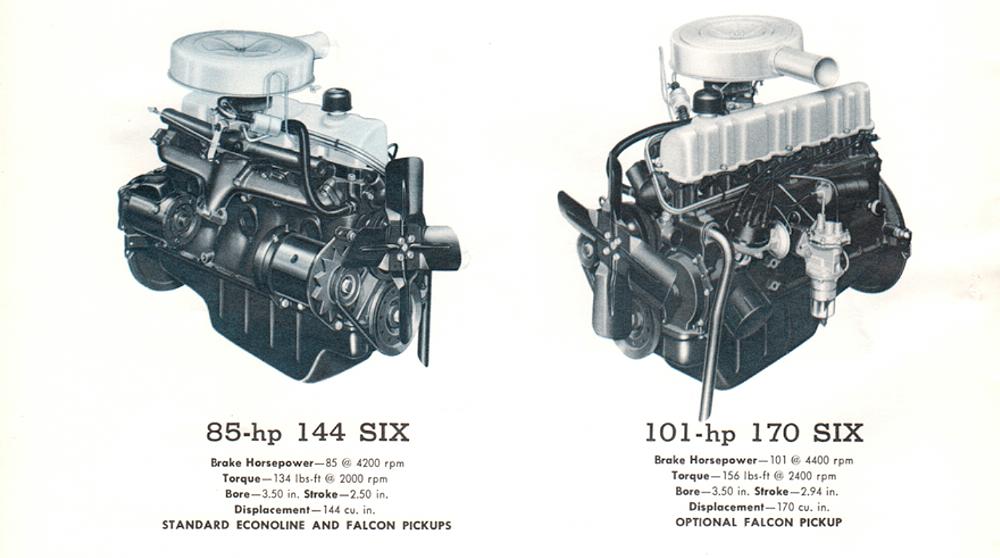
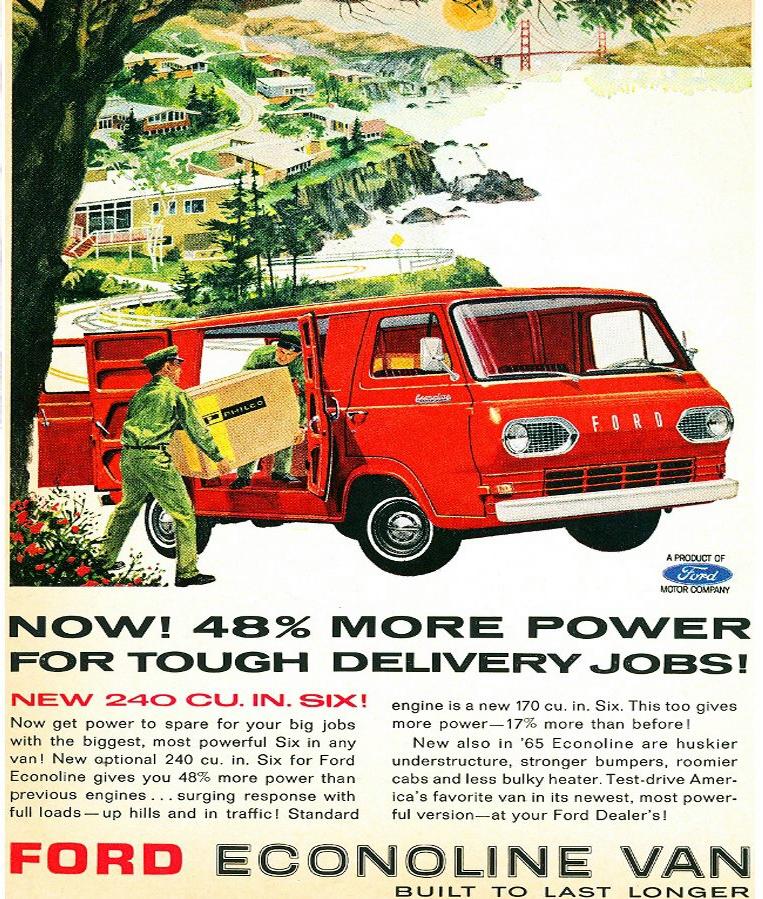
Initially powered by the 85 hp (63 kW) 144 cubic-inch inline six that was the standard engine of the Falcon, the Econoline was offered with a 101 hp (75 kW) 170 cubic-inch inline-six as an option. In 1965, a 240 cubic-inch inline-six became the optional engine, with the 170 six becoming standard. A three-speed manual was standard, with a Dagenham four-speed manual introduced for 1963 and discontinued in 1964; the 170 cubic-inch engine was offered with a 3-speed automatic in 1964, and the larger two engines were both offered with a 3-speed automatic as an option thereafter.
In line with Volkswagen, the Econoline positioned the front seats above the front axle, making it a cabover-style configuration, similar to the Jeep Forward Control. Other elements of its design were borrowed loosely from the Ford Thames 400E produced by Ford of Britain (the predecessor of the Ford Transit), including its grill configuration.
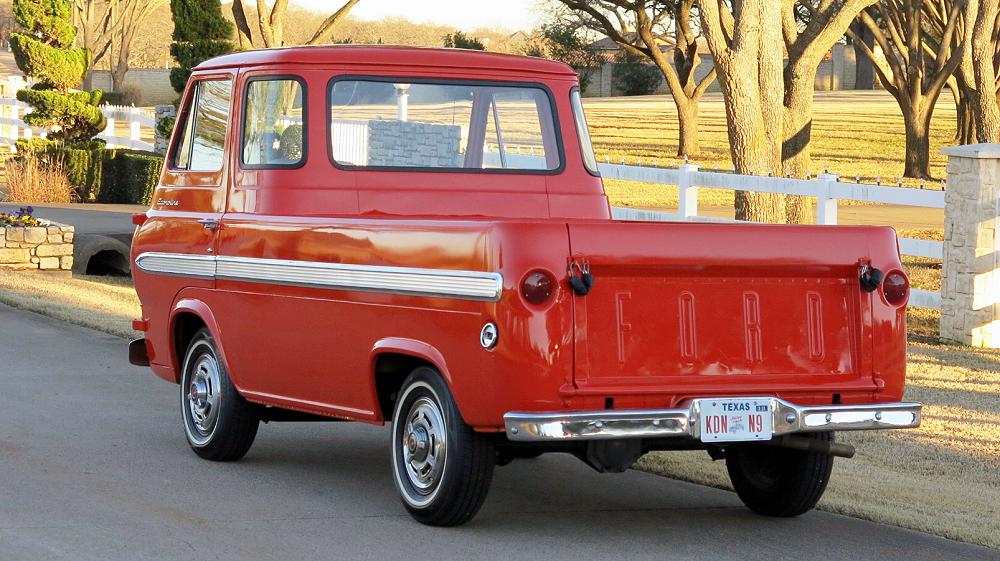
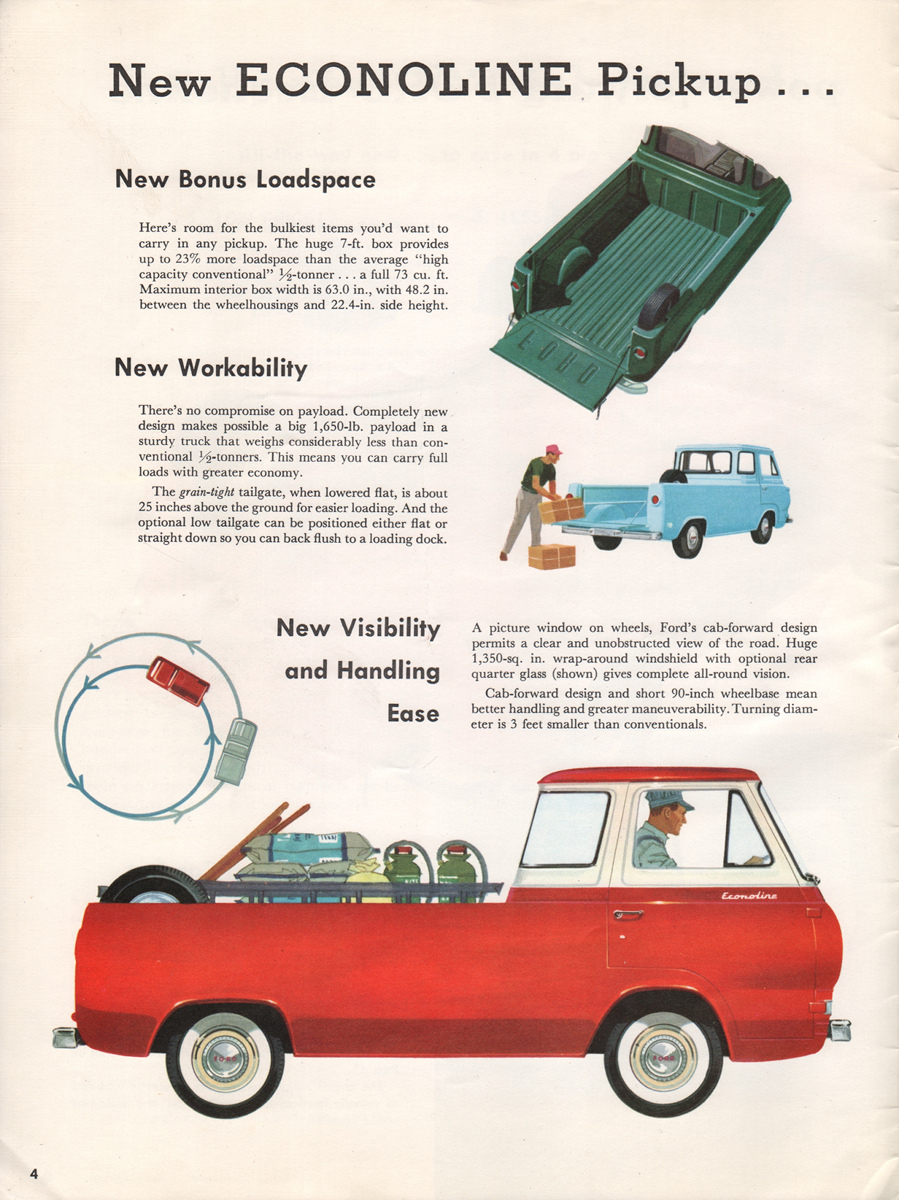
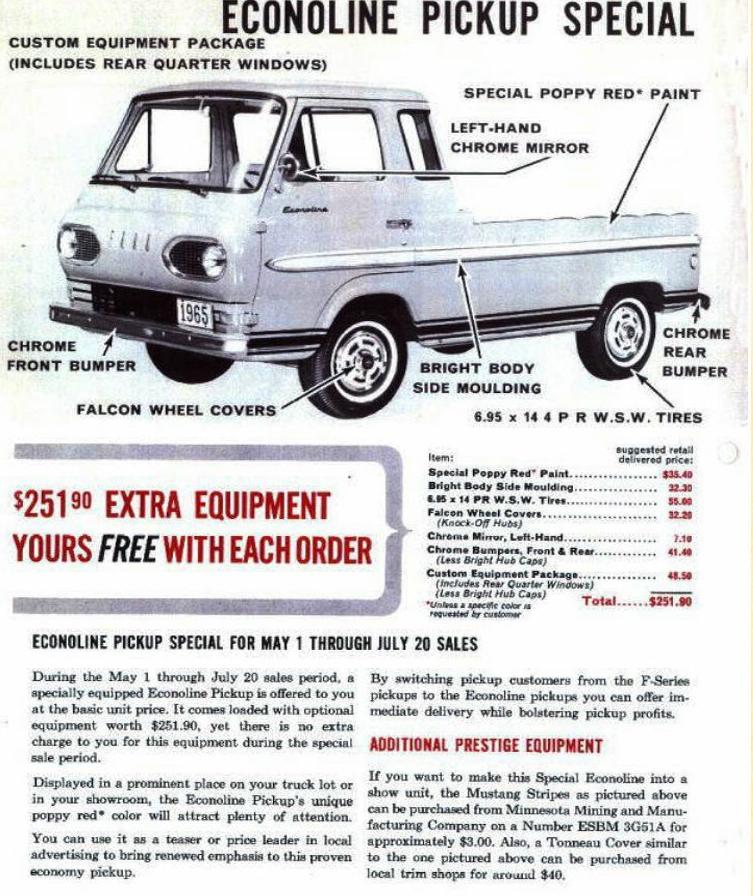
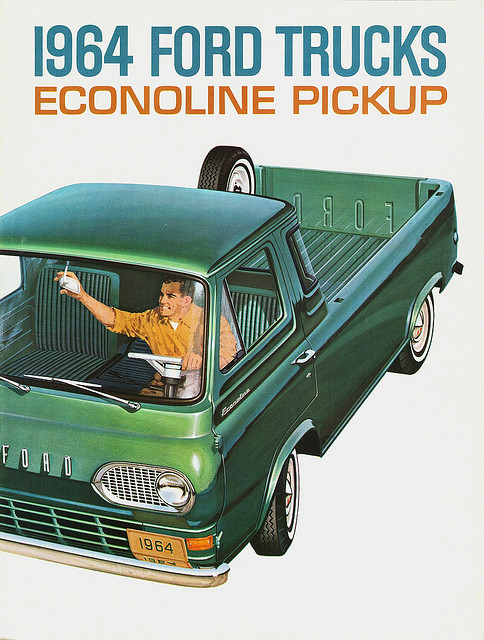
Using a mid-engine chassis, the Econoline pickup truck saw no engine intrusion into the cargo bed. Although, in 1965 with the offering of the larger 240 cubic-inch engine there was a slight intrusion into the cargo bed providing clearance for the larger transmission bellhousing. The Econoline pickup was offered in two window configurations: 3 windows and 5 windows with windows in the rear cab corners to provide better visibility. Early in 1965 the pickup was offered as a Spring Special with a special trim package. While far shorter than an F-100, the pickup was configured with a seven-foot-long cargo bed.
The Econoline pickup was only produced during the first generation of production, ending production after the 1967 model year. In 1961, Ford projected the pickup leading the van in sales; however, buyer preferences weighed heavily towards the van configuration. The pickup accounted for only ten percent of 1961 Econoline production.
Unbalanced Becomes Balanced
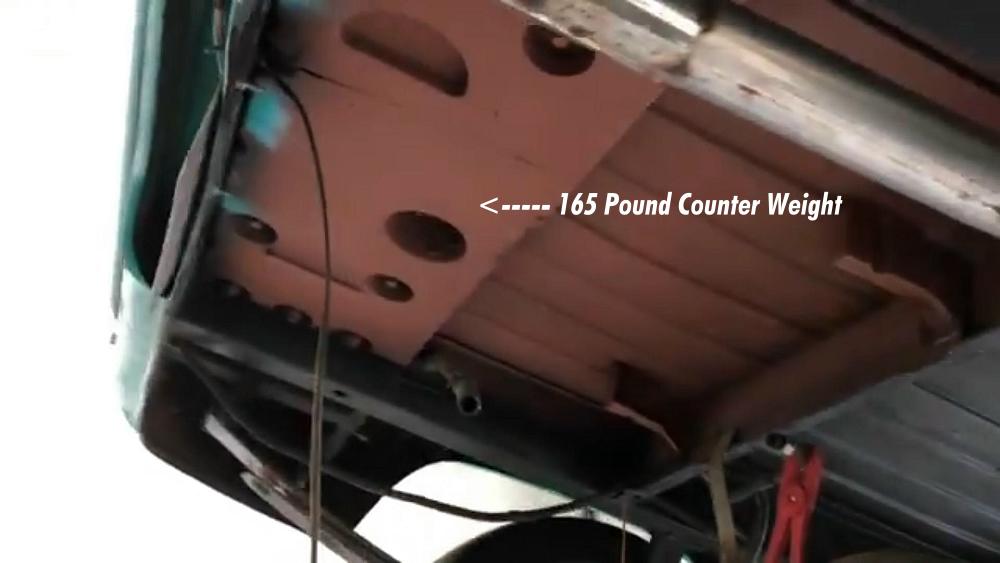
During testing, Ford discovered that the trucks rear had a tendency to raise up under panic stops. This caused the rear wheels to lose contact with the pavement. It got even worse at higher speeds and harder breaking. The solution was to add a 165-pound weight under the back end of the trucks bead.
Mercury Econoline
The first-generation Econoline was sold by Ford of Canada by both Ford and Mercury. Alongside the M-series truck line, the Mercury Econoline allowed for Ford of Canada to maximize its presence in rural areas served by either a Ford dealer or a Lincoln-Mercury dealer, but not both. Largely identical to its Ford counterpart with only minor exceptions of badging, the Mercury Econoline product line was sold as a pickup, cargo van, and passenger van.
In 1961, the pickup truck commenced production at Oakville Assembly in Canada; later that year, Mercury Econoline pickup production shifted to the Lorain, Ohio assembly plant. From 1962 to 1965, Mercury sourced Econoline vans and pickups from Oakville, with all later vehicles imported from the United States.
Production numbers of Mercury Econolines were low; for example, a total of 1,291 Mercury Econoline pickup trucks were built in 1965. During 1968, Mercury ended its sale of light trucks, discontinuing the M-series. Subsequently, the next van sold by Mercury was the 1993 Mercury Villager minivan.
Specifications
| Powertrain | |
|---|---|
| Engine | 144 cu in (2.4 L) Falcon Six I6 170 cu in (2.8 L) Thriftpower Six I6 240 cu in (3.9 L) Truck Six I6 |
| Transmission | 3-speed manual 4-speed manual 3-speed Cruise-O-Matic automatic |
| Dimensions | |
| Wheelbase | 90.0 in (2,286.0 mm) |
| Length | 168.3 in (4,274.8 mm) 186.3 in (4,732.0 mm) (Econoline Super Van) |
| Width | 75.0 in (1,905.0 mm) |
| Height | 76.9 in (1,953.3 mm) |
Features
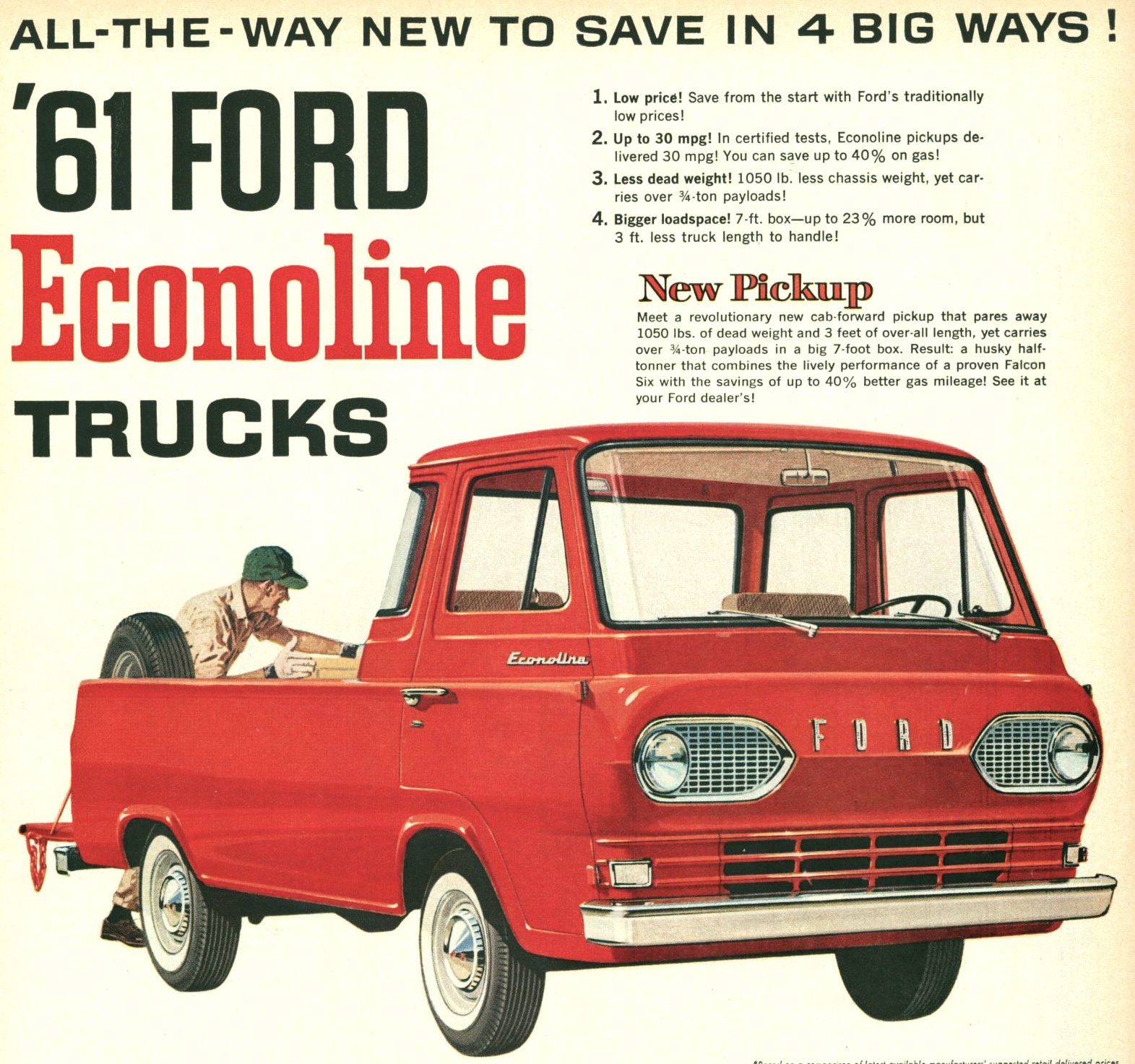
- 7.5 FT Bed (first extended bed truck)
- Roomy cab
- Storage behind rear seats
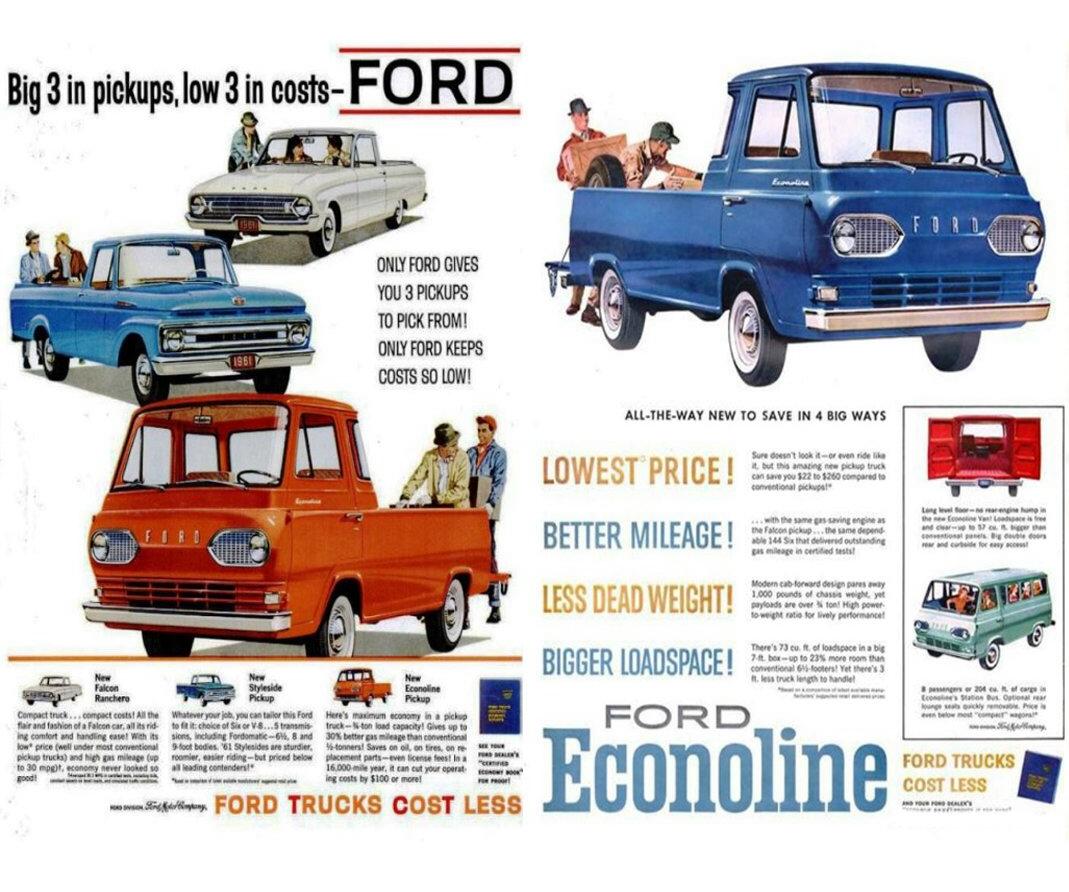
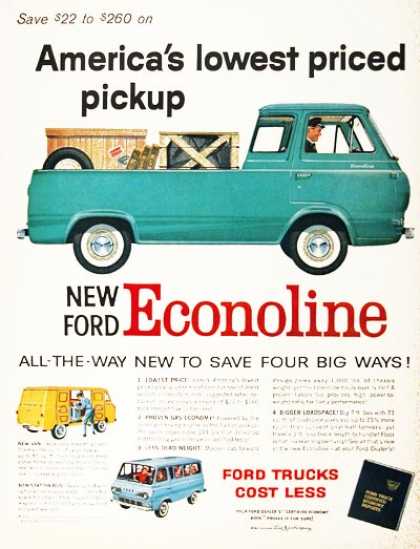
- Fuel economy of 25-30 miles per gallon (mpg)
- Low total cost of ownership
Year By Year
From 1962 to 1967 several changes and options were provided for the Econoline pickup. Some of these features and additions are detailed below.
- In 1962 an optional 170 CID V6 was offered
- In 1963 payload capacity was increased
- In 1963 an optional custom cab was offered
- In 1963 a heavy-duty package was offered that included: reinforced frame, stiffer springs, 14 inch wheels and tires, stronger rear axle.
- In 1964 stronger and larger bumpers were added
- In 1964 an automatic transmission was available as an option
- In 1967 a dual brake master cylinder, padded sun visors, two speed windshield wipers and back up lights were offered.
Sales Numbers
The first year (1961) 14,893 pickups were made which included nearly 12K standard and 3K custom models. With 11K made in 1963 and dipping to under 3,000 units for 1966 and 1967 the Ford Econoline Pickup demonstrated falling sales throughout its lifespan.
Advertisements
Click the images to enlarge.
About The Author

Growing up, my father always believed that every family needed a truck—there’s just something about having a vehicle capable of hauling anything at a moment’s notice. That philosophy stuck with me, and it’s been the foundation of my lifelong passion for Ford trucks.
While I’m best known for my work with Ford Rangers, I’ve owned a wide variety of Ford trucks over the years—including F-150s, F-250s, F-350s, and even larger rigs like the Ford Excursion, Ford Expedition, and a 1982 Ford Econoline Sportsmobile camper van. I’ve used these vehicles for everything from family transportation to towing car trailers and campers, and each one has fueled my love for Ford’s versatility and durability.
I especially enjoy the styling of 1970s and 1980s Ford trucks—the bold designs, rugged presence, and classic charm are timeless. Sharing my passion for Ford trucks, vans, and SUVs with other enthusiasts online brings me a great deal of joy, and it’s why I created Blue Oval Trucks.
This website is dedicated to helping Ford truck enthusiasts explore, learn about, and celebrate these incredible vehicles. While I share my expertise and experiences here, Blue Oval Trucks is an independent enthusiast site and is not affiliated with Ford Motor Company.