
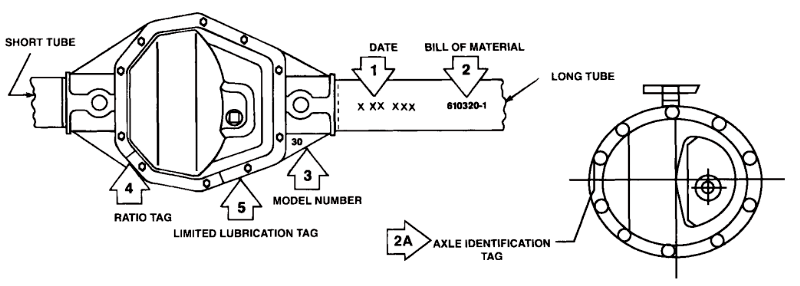
All Spicer Carrier Type axles are identified with a manufacturing date (1) and Bill of Material number (2) stamped on the right or left hand tube on driving axles. The Bill of Material number may also be found on the carrier in some models as shown in illustration (2A). For independent front suspension (IFS) axles, the B/M number may be located at one of three locations: 1). A vertically positioned tag near the center of the right hand side support arm, 2) stamped into the left hand side support arm (opposite end of the camber adjuster), or 3) stamped into the “nose end” of the axle carrier. The location of the information will depend on the manufacturing date of the axle.
The axle model number will be cast into one of the webs as shown (3), or it can be on the nose.
Each axle contains a gear ratio tag (4), and if the axle is equipped with a limited slip differential, it will have a tag specifying the type of limited slip lubricant to be used (5).
Refer to the appropriate model number section for parts identification and a breakdown of the Bill of Material.
We no longer list BOM numbers here. There’s just too many.
Looking Up BOM (Bill of Material) Numbers:
You can look them up in these documents:
1967-1978 Dana Axles – Look up BOM numbers under specific axles
1978-1998 Dana Axles – BOM numbers start on pdf page #9
1978-1998 Dana Spicer Axle Catalog & BOM Numbers
1999-2011 Dana Spicer Axle Catalog & BOM Numbers
About The Author

Growing up, my father always believed that every family needed a truck—there’s just something about having a vehicle capable of hauling anything at a moment’s notice. That philosophy stuck with me, and it’s been the foundation of my lifelong passion for Ford trucks.
While I’m best known for my work with Ford Rangers, I’ve owned a wide variety of Ford trucks over the years—including F-150s, F-250s, F-350s, and even larger rigs like the Ford Excursion, Ford Expedition, and a 1982 Ford Econoline Sportsmobile camper van. I’ve used these vehicles for everything from family transportation to towing car trailers and campers, and each one has fueled my love for Ford’s versatility and durability.
I especially enjoy the styling of 1970s and 1980s Ford trucks—the bold designs, rugged presence, and classic charm are timeless. Sharing my passion for Ford trucks, vans, and SUVs with other enthusiasts online brings me a great deal of joy, and it’s why I created Blue Oval Trucks.
This website is dedicated to helping Ford truck enthusiasts explore, learn about, and celebrate these incredible vehicles. While I share my expertise and experiences here, Blue Oval Trucks is an independent enthusiast site and is not affiliated with Ford Motor Company.